
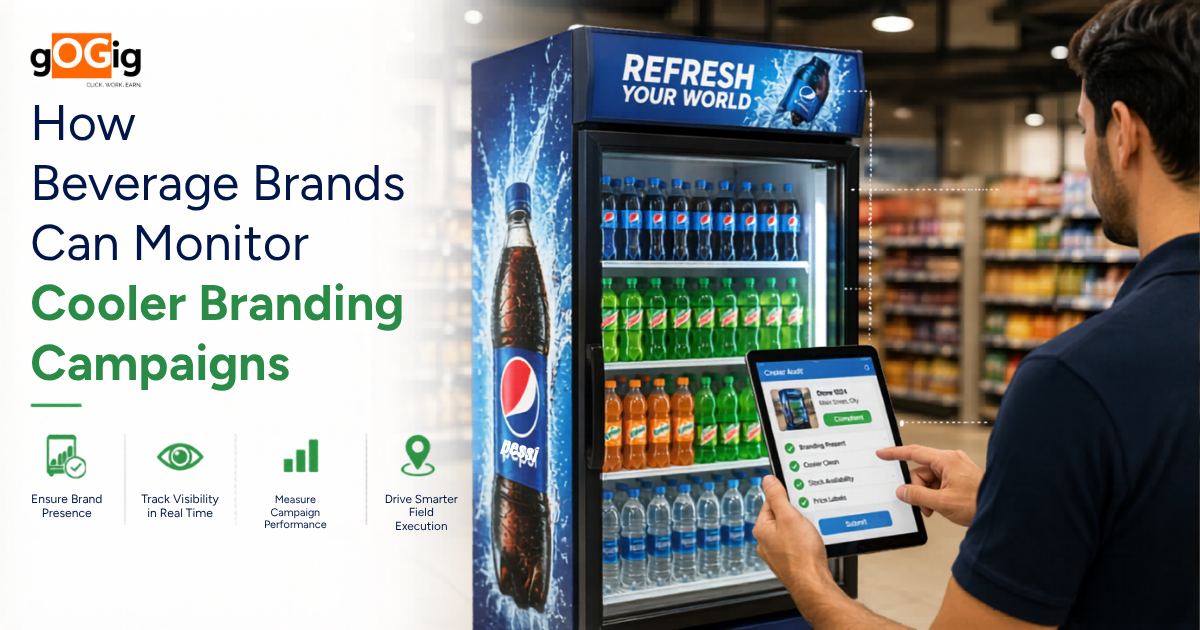
A Complete Guide to Monitoring Cooler Branding Campaigns for Beverage Brands
Discover how to track cooler branding campaigns with real-time monitoring, KPIs, and data insights to improve execution, visibility, and engagement.
If you're a beverage brand running cooler branding campaigns across multiple outlets, here's an uncomfortable truth: you probably don't know what's actually happening at most of those locations.
That's not a criticism. It's just the reality of how these campaigns work. Your team puts together a great brief, the creative looks sharp, the rollout plan seems solid and then it goes out into a network of distributors, field agents, and retail partners. From that point on, you're largely trusting that things happened the way they were supposed to.
Sometimes they did. Often, they didn't.
They know where every installation stands, live. Not at the end of the week. Not after a field agent remembers to send a WhatsApp message. Right now which outlets are done, which are pending, and which have flagged an issue.
They verify, they don't just collect. There's a big difference between receiving a photo and confirming that the photo was taken at the right place, at the right time, showing the right installation. Without GPS coordinates and a timestamp locked to live capture, a photo tells you very little. A photo taken at the wrong store, or pulled from someone's camera roll, looks identical to a genuine submission.
Beverage brands today are investing heavily in point-of-purchase visibility. Branded coolers, retail displays, and in-store activations are all part of a broader offline campaign tracking strategy that determines whether your brand actually shows up the way it was planned or just on paper. Managing this well requires more than a good brief. It requires a system.
That's exactly what platforms like gOGig are built for giving brand teams live visibility into what's happening on the ground, across every outlet, every city, and every vendor, in real time.
Why Retail Cooler Branding Execution Breaks Down Across Outlets
Think about what it actually takes for a cooler branding campaign to land correctly. The right creative has to reach the right outlet. A field agent has to install it in the right position near the entrance or checkout, not tucked in a back corner. The illumination has to work. The branding has to be the current version, not something left over from three campaigns ago.
Now multiply that by 200 outlets. Across five cities. Managed through three different distributor networks.
This is where things fall apart not because people aren't trying, but because the system for tracking execution is broken. Most beverage brands are still managing this through WhatsApp groups, email check-ins, and spreadsheets. Field agents send photos when they remember to. Reports get compiled at the end of the week, or the end of the campaign. By the time anyone spots a problem, the window to fix it has often already closed.
The result? Campaigns that look 90% compliant on paper but are closer to 60% compliant in reality. Brand guidelines that exist as PDFs nobody references on the ground. And marketing budgets that aren't delivering the return they should.
What Real-Time Field Execution Tracking Actually Looks Like
Here's the thing, monitoring a cooler branding campaign doesn't have to be complicated. It just has to be real-time, verifiable, and built into the workflow rather than bolted on as an afterthought.
The brands that get this right focus on a handful of things.
They measure in-store beverage display compliance, not just activity. Tracking that field agents submitted photos is not the same as tracking that the cooler was installed correctly. Good monitoring evaluates what's in the submission: is the creative current? Is the placement right? Does the location match the outlet plan?
And critically they catch problems while there's still time to fix them. A non-compliant installation identified in week one of a six-week campaign can be corrected. The same problem found in week five cannot.
KPIs That Actually Measure Cooler Branding Campaign Performance
You don't need a long list of metrics. You need the right ones.
Installation Compliance Rate is the most important number in any cooler branding campaign. It tells you what percentage of your planned installations actually meet your brand standards, verified through photo proof with location data. Industry experience suggests well-run campaigns with proper verification systems achieve 85–92% compliance. Brands relying on self-reported execution alone often run 20–30% below that, without realising it.
Time-to-Deployment matters more than people think. A seasonal campaign that takes three weeks to fully install across your outlet network has already missed a significant chunk of its promotional window. Tracking how quickly installations are confirmed gives you early warning when rollouts are falling behind.
Geographic Coverage Rate for Multi-Location Campaign Tracking tells you what percentage of your target outlets have a confirmed, compliant installation. A campaign planned for 300 outlets running at 65% geographic coverage means 105 locations your brand simply isn't showing up in.
Vendor Performance Benchmarking is the one most brands skip and it's often where the most useful insight hides. When you track compliance rates by distributor or field agency, you quickly see which execution partners are reliable and which are consistently falling short. That's a commercial conversation to have with data, not gut feeling.
The Hidden Problem With Self-Reported Field Execution Proof
This is something most beverage brand teams don't talk about openly but it's one of the biggest reasons cooler branding campaigns underperform.
When execution proof is self-reported by distributors or retail partners, there's an obvious incentive to over-claim. A cooler installed in the wrong position gets reported as compliant. A photo taken at a different store gets submitted for the right one. An old creative version gets photographed and marked as current.
Without an independent verification layer, you have no way to know the difference. You're looking at a spreadsheet of green ticks that may not reflect what's actually on the ground.
The only way to close this gap is to take verification out of the hands of the people doing the execution. That means GPS-confirmed locations, tamper-proof live photo capture, and a system that flags anomalies automatically rather than waiting for a human to notice something looks wrong.
How gOGig Solves Offline Campaign Verification for Beverage Brands
gOGig is a platform built specifically to give brand teams real-time visibility into offline campaign execution. For beverage brands managing cooler branding across distributed outlet networks, it solves the exact problems that WhatsApp groups and spreadsheets cannot.
No app download needed for field teams. The biggest reason monitoring rollouts fail is that field agents don't adopt the new system. gOGig works through WhatsApp, which field agents already use every day. They photograph the installation and send it to a single WhatsApp number. That's it. No onboarding, no training, no resistance.
Every submission is automatically verified for location and timing. Each photo that comes through gOGig is instantly checked against three things: GPS coordinates confirming the outlet location, a timestamp confirming when it was taken, and live capture confirmation so nobody can submit a photo from their gallery or from somewhere else entirely. Your proof of execution is actually proof not just a collection of images.
Geo-fencing flags wrong placements automatically. For cooler branding, position within the store matters. gOGig's geo-fencing technology flags any submission where the GPS coordinates fall outside the approved zone for that outlet. A cooler installed in the wrong section of the store, or at the wrong outlet entirely, gets flagged without anyone manually reviewing every submission.
One dashboard for multi-location campaign tracking across all vendors. Instead of chasing updates from multiple distributors across different cities, your brand team sees everything in one live view compliance rate by region, submission gaps by outlet, vendor performance side by side. The information that used to take a week to compile is there instantly.
Anti-fraud detection catches duplicate submissions. gOGig links specific branding assets to specific outlet IDs. If someone tries to reuse the same photo or the same execution proof across multiple locations a common workaround when field agents are under pressure the system catches it automatically.
Independent third-party BTL campaign monitoring. This is what makes gOGig's verification meaningful. The platform has no commercial relationship with the vendors executing your campaign. It has no incentive to approve non-compliant submissions. What you see in the dashboard is what's actually happening on the ground.
Frequently Asked Questions About Beverage Cooler Branding Campaign Monitoring
What is the most reliable way to verify cooler branding compliance across multiple outlets? GPS-verified, timestamped photo submissions captured via live camera validated automatically against location and creative criteria is the current standard. Platforms like gOGig add geo-fencing and anti-fraud layers that close the verification gaps in self-reported systems.
What compliance rate should beverage brands expect from a well-run cooler branding campaign? With structured field execution tracking and independent verification, 85–92% is achievable. Campaigns using self-reported proof without verification typically run 20–30% below what the brand team believes.
Can gOGig handle multi-location campaign tracking across different cities and vendor networks simultaneously? Yes. gOGig is built for exactly this scenario — multiple cities, multiple vendors, consolidated into a single live dashboard with vendor-level compliance breakdowns.
Does gOGig require field agents to download a new app? No. Field agents submit photos through WhatsApp, which they already use. This is the primary reason adoption works where other monitoring rollouts fail.
How early in a cooler branding campaign should monitoring begin? From day one of the installation window. Identifying non-compliance in week one of a six-week campaign leaves time to correct it. Week five does not.
The Real Cost of Not Monitoring Your Cooler Branding Campaign
Cooler branding represents real investment creative production, logistics, distributor relationships, installation costs. What's often missing is the last piece: a system to verify that the investment actually landed where it was supposed to.
Without real-time field execution tracking, you're running campaigns on hope. You're paying for 300 compliant installations and getting 180. You're reporting strong campaign coverage while large portions of your outlet network have the wrong creative, poor placement, or no installation at all.
Real-time monitoring, GPS-verified proof, and a live compliance dashboard don't just improve execution quality. They give you the visibility to act during the campaign not after it and the data to make every future campaign smarter.
That's what gOGig is built to give beverage brands. And for any team managing cooler branding at scale, it's the difference between assuming the campaign worked and actually knowing it did.